
Podcast Episodes
AE 669: 10 Better Ways to Say YOU in English
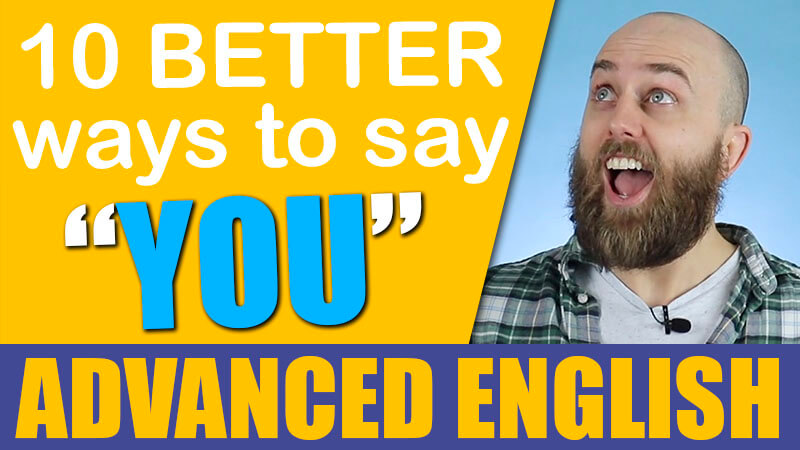
Learn Australian English in this episode of the Aussie English Podcast where I teach you 10 better ways to say YOU in English!
Get more out of every episode!
Podcast PLUS members get access to
1500+ episodes with full transcripts
The advanced player with follow-along transcript
Members Only Podcasts you can't hear anywhere else
MP3 + PDF downloads, new episodes every week
Transcript of AE 669: 10 Better Ways to Say ‘YOU’ in English
G'day, you mob! And welcome to this episode of Aussie English, where I am going to teach you, you guys, you all ten different ways to say 'you' in English.
Alright, so you, mob. You ready? Let's go.
So, in English, we obviously have the pronoun 'you', which is singular and plural, right? If I say, 'how are you?' I could be referring to one person, I could be referring to two people. I could be referring to a thousand people. It's singular and plural. Because this is the case and we have the same word for both singular and plural second person, quite often in English, what we do to differentiate these and make these more obvious is that we create these expressions, we add words to the word 'you', in a sort of phrase, to show that we're specifically referring to multiple people.
So, for example, you might hear 'you guys', 'you mob', 'you folks', y'all if you're in America.
And sometimes within sentences, you might say words like 'guys', 'folks', 'everyone' and 'people' when someone is referring, someone speaking, referring to a group of people and not just one person. So, let's go through some examples.
Number one: 'you guys'.
I mean, one of the things that you guys are going to talk about.
And I want you guys to meet Ned.
It sounds like it drives you guys nuts, too.
This is informal. It's used all the time in all areas of English, whether you're in America, Britain, Australia, you're going to hear 'you guys'. Now, the word 'guy', it can mean a male, but it doesn't specifically mean this when we say 'you guys', it means more like you people. It's a pluraliser, if that's a word. It's a way of making you plural. 'You guys'. So, you might hear people say, 'what are you guys up to today?',right? What are you, plural, up to doing today? What are you guys up to today? 'You guys', 'you' plural.
The next one, and this is used commonly in Australia, is 'you lot'.
It's up you lot to decide whether we've done a good job.
I'll admit it, but I'm proud of you lot.
I know that this probably doesn't affect you lot much.
Right? If you have a lot of something, you have many of that thing. So, 'you lot' is a group of people. So, hey, you lot. You want to go to the beach? Right? 'You lot'. You guys, you people, do you want to go to the beach?
Number three here. Another very, very common one in Australia that you hear all the time, 'you mob'.
It's thanks to you mob.
Hey, you mob. Don't let that fella pressure you.
I also want to acknowledge your mob.
I use this quite a bit. 'You mob'. A 'mob' is a group of kangaroos in Australian English. It is the group, the plural, of kangaroos. There's a mob of kangaroos. But we use this quite often to refer to many people. 'You mob', there's a mob of people down there. How's your mob? How's your family? How's your mob going? So, 'you mob'. You might hear this if someone says, 'do you mob want to come over for a barbie on the weekend?'.
'Do you', plural, you guys, you people, want to come to my house for a barbecue? Do you mob want to come to mind for a barbie on the weekend? 'You mob'.
Now, the last one here that's sort of in this vein of 'you' plural is 'yous'.
And you're looking after each other, two of yous working at the coal face.
Do yous feel that way that things… do you think there is a shift?
Or yous, this is used quite a bit in Australia as well. It's probably also used in Ireland, I think, but it is where we've put an 's' on the end of the word 'you' to make it plural. This is very informal and tends to be used, to put it politely, by the uneducated part of society. Most people won't use this formally or even informally usually, but you're going to hear it a lot if you're in places like Australia.
So, I remember when I was a younger kid at school and I had a lot of friends trying to show off the fact that they were, I guess, different, you know, they kind of took pride in the fact that they weren't necessarily educated and they would often use slang or incorrect grammar like 'yous', right? Did yous want to go for a swim? Did yous want to go to the movies? Did yous have something planned today? What are yous up to? What yous up to? What are yous doing?
So, they would use that quite a lot. I'd recommend not using it, totally up to you really. But yeah, it's associated with being a bit of a bogan, ok? So, no offence any bogans.
Oh, one more that I've just forgotten, but I want to mention, 'you all'.
I want you all to pretend that you are participants in a study.
I hope you all had a good journey here.
And I'm say so thrilled for you all.
Now, we can use this in Australian English, 'you all', what are you all doing? And we'll separate those words out, 'you all'.
What are you all doing tonight? What are you all doing tomorrow? What are you all thinking about having for dinner? Are you all coming to the party? Are you all interested in staying the night?
'You all', we'll use it separated. Americans, though, contract this and you'll quite often hear 'y'all'.
I don't just read the book, y'all.
I said, nah, I don't feel right about that. Y'all go ahead, y'all go ahead.
Right? Y'all, Y-'-A-l-l, y'all.
And, if I can do an American accent, they might say something like, 'Hey, y'all. What's up?' Hey, y'all. Y'all. Hey, y'all, what's up? Y'all.
I can't really do it, sorry, Americans, but that's slang that you might hear in the United States or Canada, 'y'all', ok? Y'all'. You'll probably confuse Aussies if you use that.
Now, the last ones that I want to mention here are plural words like 'guys', 'folks', 'everyone' and 'people', that are sometimes used in sentences to show that you're referring to a group, ok? You might say something like, 'hey, guys'.
Ok, guys, welcome back to Colour In Your Life.
Alright, guys. So, be sure to check out our sister network…
Guys, this is basically a map of some of the most important places in the human journey.
What are you up to? Right? What are you up to? Plural, 'guys'. So, you use the plural 'guys' in that sentence somewhere, 'hey, guys, what are you up to? Hey, what are you up to, guys?' to show that you're addressing a group of people.
In Australia we can use 'folks'.
Oh, g'day, folks, and welcome back to Colour In Your Life.
Folks, my pleasure to be here in lovely Los Angeles.
Howdy, folks, is Barry here for My Virgin Kitchen.
And again, this is a confusing word because 'folks', if you talk about it in a possessive way, 'my folks', it's talking about my parents, my mom and my dad. Whereas if I say, 'hey, folks' I'm addressing a group of people, it's just plural group of people. So, you might be in a museum and you're a tour guide and you might say, 'ok, folks, come over here, gather in. We're going to go for the tour before lunch'.
'Alright, folks, everyone come in', you know?
Hey, folks'. I've just mentioned everyone. So, that is number three here. You can also obviously say 'everyone'. That's a pretty obvious plural word in English. 'Everyone'. Hey, everyone.
Alright, good bye, everyone.
Hey, everyone, welcome to 30 days of yoga.
Alright. Hey, everyone. Thank you so much for coming out.
What are you doing everyone? You know? Is everyone coming over this weekend? 'Everyone'. And the last one here is sometimes you might hear 'people'.
It's alright, people.
Hey, people. My name is Akala.
Come on, people. We can do better than that.
So. Alright, people, let's get a move on.
Let's get moving, people, let's get going, let's go.
So, there you go, guys. They were 10 or so different ways of saying 'you', but plural in English. Hopefully this episode has helped you learn a little bit more about informal English. And if you decide to use any of these or not, that's up to you. But the most important thing is hearing them and then being able to understand them when speaking in English to know what people are trying to say.
Ok? So, I hope you enjoy this episode and I'll see you in the next one. Peace .
More podcasts

How Can Someone Steal Money From an Empty Gift Card?
Why Is This Dingo Protected in Victoria but Controlled in South Australia?

Is Australia Really the Best Place to Survive the Apocalypse?