
Pronunciation
AE 1115 - Advanced English Pronunciation Lesson: Chess vs Chairs - /e/ vs /eː/
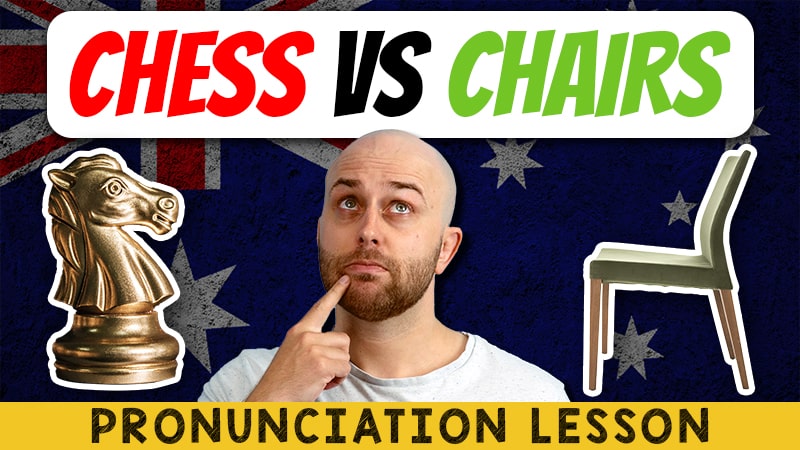
Learn Australian English on the Aussie English podcast as I teach you how to pronounce the short and long e sounds in 'chess' and 'chairs'.
In today's episode...
G'day, you mob!
In today's Australian English Pronunciation lesson, I'm going to teach you the difference between two E sounds: /e/ and /e:/
We will begin this lesson with a practice on how to say each sound - listen carefully to the sounds made!
I will then give you a set of minimal pairs of words so you can learn how to distinguish each sound.
And lastly, stay until the end of this video lesson. Listen to the vowel sounds and determine if it's a short e or long e sound.
See you in the next lesson!
Is there anything you want to ask me? Drop in your questions here: https://aussieenglish.com.au/askpete
** Want to wear the kookaburra shirt? **
Get yours here at https://aussieenglish.com.au/shirt
Improve your listening skills today – listen, play, & pause this episode – and start speaking like a native English speaker!
Watch & listen to the convo!
Get more out of every episode!
Podcast PLUS members get access to
1500+ episodes with full transcripts
The advanced player with follow-along transcript
Members Only Podcasts you can't hear anywhere else
MP3 + PDF downloads, new episodes every week
Available only for Podcast Plus users.
Transcript of AE 1115 - Chess vs Chairs - /e/ vs /eː/ | Australian English Pronunciation
Pete, have you got enough *chairs for the party? Chess for the party? It's a birthday party, why do we need chess? Well, what are people going to sit on if we don't have any *chairs? Oh, you mean "chairs". Yeah, *chairs. That's what I said, mate. No, you said chess, like the board game chess. Chairs are what you sit on. I'll make you a lesson to teach you the difference.
G'day, you mob. Pete here, from Aussie English. I have been teaching thousands of students for the last six years how to master their Australian pronunciation, and today's video is going to help you just the same. So, today I'm going to help you master the difference between two very similar vowel sounds in Australian English, /e/ and /eː/.
But before we get started, though, guys make sure that you go down into the description and download the worksheet so that you can print this out as a PDF, you can follow along and you can see all of the exercises and words and everything like that. It'll make following this lesson a lot easier, and you'll get all my future PDF lessons and videos as well. All right, part one, how to pronounce /e/.
So, I'm going to say a list of words here, listen and repeat after me. "/e/. Head. Set. Kept. Flex. Peck. Leg. Met. Egg. Fetch. Text." So, interestingly, the /e/ vowel sound in English is always followed by a consonant sound, you're never going to have a word that just ends with a vowel sound /e/.
Whereas the vowel sound /e:/, the long version of the /e/ vowel sound is often heard at the ends of words with no consonant after it. Which we'll go over in a sec. But before we do that, guys, if you are enjoying this video, could you please give the like button a cheeky little boop as it'll show YouTube's algorithm that you're enjoying this video and that it should show this to other English learners just like you? Cheers.
Okay. Part two, how to pronounce the vowel sound /e:/. So, effectively all you need to do here, guys, compared to the vowel sound /e/ is hold that same vowel sound for a moment longer, so you'll hear /e/ the short one and /e:/ the longer one. Right. There's no other difference in terms of articulation in the mouth, it's the same sound, one's short, ones long. /e/. /e:/.
So, let's go through a little list of words. "/e:/. Rare. Hair. Air. Bared. Scared. Yeah. Swear. Aware. Where. Tear." Great job, so you probably noticed quite a few of those words just end with the vowel sound /e:/ with no consonant after it.
Remember, guys, if you want all the detailed tutorials so that you can master every single vowel sound and every single consonant sound in Australian English, be sure to get my Australian pronunciation course. Inside, you will learn to quickly master all of the different sounds in Australian English.
You'll learn how to use the IPA, the international phonetic alphabet, and you'll also get access to 25 advanced pronunciation lessons covering sounds like the syllabic N, the syllabic L, the dark L, how to use the /r/ sound in Australian English, the T-flap, everything like that. So, go down into the description and click the link or just go to www.AussieEnglish.com.au/APC.
All right, part three. We'll do a little comparative pronunciation exercise here. So, this was actually a little difficult to create because the only minimal pairs I could find for words with these two vowel sounds, right, so a pair of words that only differ between the vowel sounds /e/ and /e:/ always seem to end with D.
So, I'll do five pairs of real words and then five pairs including made up words in order to let you hear other situations with other sounds next to these vowel sounds.
Let's go. "/e/. /e:/. Bed. Bared. Fled. Flared. Dead. Dared. Head. Haired. Fed. Faired. Let. Lairt. Beg. Bairg. Meh. Mare. Egg. Airg. Text. Tairxt." Great job, guys. Right, now, it's time for part four, a listening comprehension quiz. So, this is where I'm going to include pairs of words like we just went over, but I'm only going to say one of these.
So, I'll display both words or both options on screen, and I'm going to test your listening comprehension to see if you can hear which one of these words I'm saying. So, this is a great way of developing your ear so that you can then pronounce these words yourself when speaking English. You've got to hear it before you can say it. All right, are you ready? When I say each of these words, do you hear the /e/ sound or the /e:/ sound?
Let's go. "Bed. Rare. Egg. Where'd. Tread. Sairt. Bairg. Meh. Airg. Text." Great job, guys. Remember some of the words there aren't real words, but I use them to be able to include both vowel sounds as minimal pairs. So, that's it for today, guys. I hope you enjoyed the lesson. Don't forget you can listen to all of these lessons as audio files on the Aussie English podcast.
You can download my free app so that you can listen to these episodes anywhere, any time. It's a great way to practise your English, especially whilst using your dead time, right?
Whilst you're commuting, cleaning the house, going to the gym, and you can have something in your ears and be working on something else at the same time. If you want to keep learning English pronunciation with me, check out this video up here where I teach you the difference between the vowel sounds /ɔ/ and /oː/. See ya!
More podcasts

How Can Someone Steal Money From an Empty Gift Card?
Why Is This Dingo Protected in Victoria but Controlled in South Australia?

Is Australia Really the Best Place to Survive the Apocalypse?